PZP
Specificatie van de Nuts-zorgtoepassing Palliatieve Zorg Planning (PZP), ook wel Advance Care Planning (ACP) genoemd.
Deze specificatie is in lijn met de IHE-profielen en de Twiin-zorgtoepassingen opgedeeld in de volgende volumes:
-
Volume 1 geeft een functioneel overzicht van de zorgtoepassing PZP en de daarbij behorende eisen (in Dutch)
-
Volume 2a bevat de technische afspraken voor de zorgtoepassing PZP (in English)
-
Volume 2b bevat alle losse transacties die gebruikt worden voor de zorgtoepassing PZP (in English)
-
Volume 3 is een verwijzing naar de informatiestandaard en de meta-informatie die worden gebruikt in de zorgtoepassing PZP (in Dutch)
- PZP Volume 1 - Functioneel overzicht
- PZP Volume 2a - Technical Agreements
- PZP Volume 2b - Transactions
- PZP Volume 3 - Content
- Connectathon 29 Sept 2025
PZP Volume 1 - Functioneel overzicht
WIP!
BZ: moeten we de drie verschillende momenten los uitwerken? Dus 1) inzage (bij spoed/ambu/OHCA bijv), 2) overdracht (bij veranderen van zorgorganisatie of lijn, bijv thuiszorg naar Hospice of oncoloog naar huisarts en wijkverpleging) of 3) samenwerking (bijvoorbeeld tussen huisarts of specialist in het ziekenhuis en wijkverpleging)
Doel en relevantie
Het doel van deze usecase is om behandelgrenzen en -wensen van zorgvragers — zoals afgesproken in het kader van proactieve zorgplanning (PZP) — digitaal beschikbaar te maken voor geautoriseerde zorgverleners binnen het netwerk van de zorgvrager. De gegevens worden eenduidig vastgelegd, (mede) ontsloten via de Nuts-infrastructuur, en zijn snel en veilig te raadplegen bij spoed, overdracht of reguliere zorgmomenten.
Hierdoor wordt gewaarborgd dat behandelwensen bekend zijn en gerespecteerd worden, onafhankelijk van tijd, locatie of zorgaanbieder.
Bedrijfsrollen
| Rol | Toelichting |
|---|---|
| Vastleggende zorgverlener | De zorgprofessional die het PZP gesprek gevoerd heeft met de zorgvrager en de informatie vastlegt. |
| Raadplegende zorgverlener | De zorgprofessional die PZP gegevens wil opvragen bij een andere zorgorganisatie. |
| Bronhouder* | De zorgorganisatie waar de zorgvrager (eerder) zorg ontvangen heeft, en die het PZP deelt met bij de zorg betrokken professionals bij een andere zorgorganisatie. |
*Om consistentie te bewaren binnen de usecases die over Nuts gaan, gebruiken we hier de term Bronhouder.
Proces en context
Patient Journey:
TODO
PZP Volume 2a - Technical Agreements
This volume describes the technical side of the agreements to realize data availability for the use case Advance Care Planning. This volume provides the technical agreement needed for transmitting the data between parties. Technical agreements are made on
-
identifying health organizations -
identifying vendors -
identifying professionals -
authenticating vendors & health organizations -
authenticating professionals -
localization -
addressing -
data request
Exchange pattern: indexed pull
Due to the nature of the use case, the exchange pattern is indexed pull. In short this means that fetching data globally consists of two steps: Localization: Localising the data holders (via one or more indices) and then Data request: actually reuqesting the data at each known data holder.
Identifying health organizations
The use case Advance Care Planning makes use of the generic technical agreement Identifying health organisations.
Identifying vendor organizations
The use case Advance Care Planning makes use of the generic technical agreement Identifying vendor organisations.
Identifying professionals
The use case Advance Care Planning makes use of the generic technical agreement Identifying professionals.
Authenticating health organisations
The use case Advance Care Planning makes use of the generic technical agreement Authenticating health organisations.
Authenticating vendor organizations
The use case Advance Care Planning makes use of the generic technical agreement Authenticating vendor organizations.
Authenticating professionals
The use case Advance Care Planning makes use of the generic technical agreement Authenticating professionals.
Localization
The use case Advance Care Planning does not make use of a generic technical agreement. The use case Advance Care Planning uses the following technical agreements:
Make data localisable:
-
COULD: Every healthcare organisation maintains a CareTeam-resource per patient that contains all known involved relevant healthcare organizations
-
LATER: For testing purposes the facilitators of the test make sure that the NVI is filled
-
LATER: Vendor that wish to do so can register the CareTeams with the NVI (specifications)
Localise:
- MUST: Get URA’s from organizations that have registered support for PZP-service from Nuts Discovery Service
- COULD: Get URA’s from data holders from local CareTeam
- LATER:
- Send bsn to NVI
- receice 1 or more URA's from data holders that host a CareTeam
- fetch at least 1 CareTeam-resource
Addressing
The use case Advance Care Planning does not make use of a generic technical agreement. The use case Advance Care Planning uses the following technical agreements:
Publish addresses
- SHOULD: Register at NutsDiscoveryService with X509Credential and DiscoveryRegistrationCredential containing a fhirBaseUrl-elemement.
- MUST: Parties that choose not to register at the NutsDiscoveryService themselves are registered at the NutsDiscoveryService via a hack
- FALLBACK: make sure you know the fhir base urls of other parties in some way (this can also be done via a local list)
Retrieve addresses
- Query the NutsDiscoveryService and use the values for fhirBaseUrl and auth-url
- FALLBACK: make sure you know the fhir base urls of other parties in some way (this can also be done via a local list)
Authorization
The use case Advance Care Planning makes use of the generic technical agreement Authorizing incoming requests.
The following access policies are used in ACP:
Rego script here
to do
Legal basis: local explicit consent
The use case Advance Care Planning uses an explicit consent that is stored locally in a system of the data holder a legal basis for the processing of data. The use case Advance Care Planning makes use of the generic technical agreement Local explicit consent.
Data request
In some contexts this is referred to as Pull.
TO DO jorrit
PZP Volume 2b - Transactions
Within this volume the transactions that are used for the use case Advance Care Planing are described.
Publish ACP data source to NVI
Later. not in scope for September 2025 hackathon
Search ACP data source at NVI
Later. not in scope for September 2025 hackathon
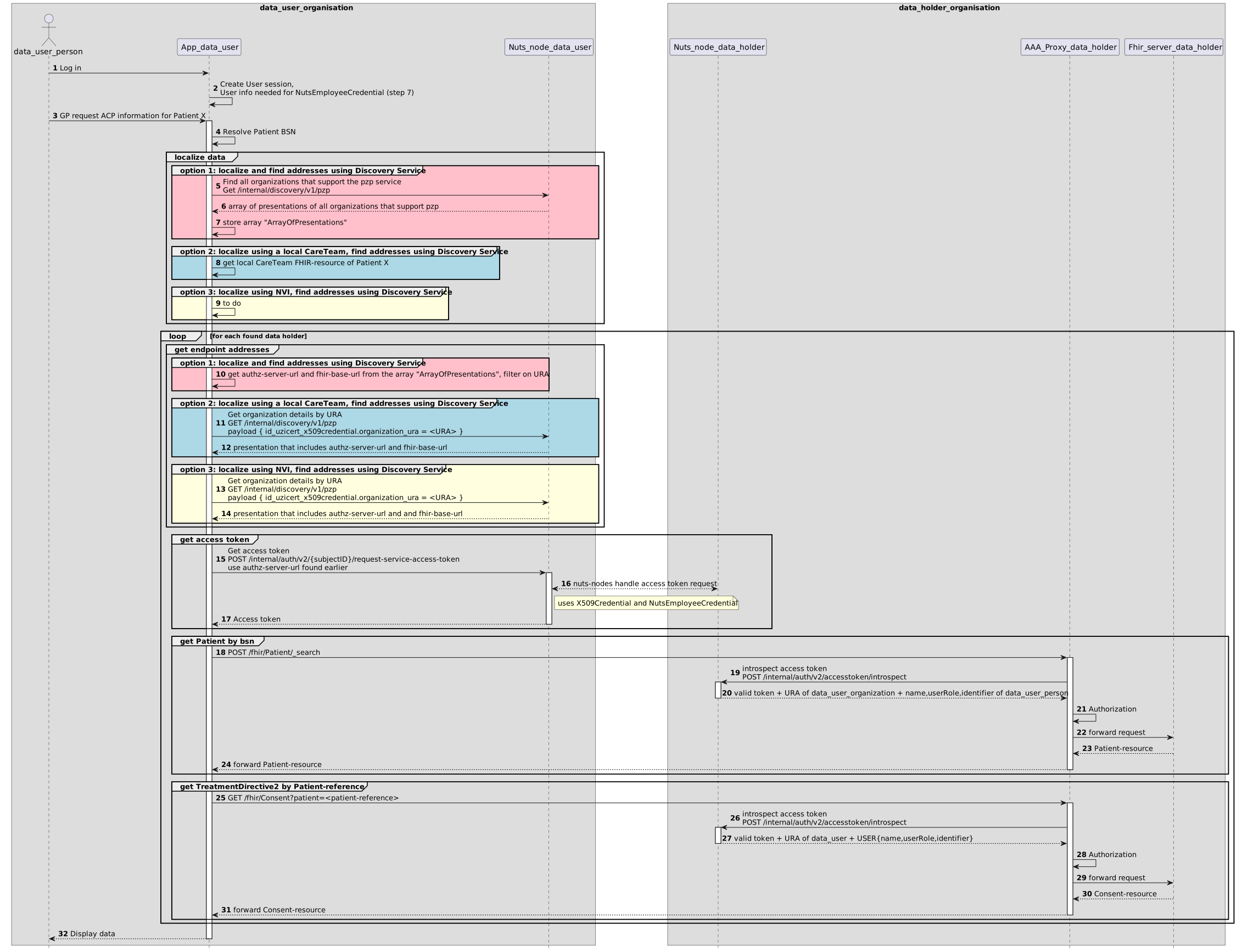
Getting data from multiple sources
Legend: If you use an option to localize data, you must use the corresponding option to get endpoint addresses. In other words: stick to 1 color!
Image:
PZP Volume 3 - Content
De zorgtoepassing PZP gebruikt als content onderstaande zibs, FHIR-profielen en EHR-archetypen. Dit artikel is een beknopte weergave van hoofdstuk 3.3 uit de Afsprakenset Proactieve Zorgplanning PZP Coalitie. De Afsprakenset Proactieve Zorgplanning PZP Coalitie is leidend.
Zorginformatiebouwstenen
Er wordt gebruik gemaakt van de zib Patient (versie 2020) en de zib Behandelaanwzijzing2
FHIR resources en queries
Voor PZP wordt gebruik gemaakt van FHIR R4. Hieronder staan de endpoints die beschikbaar gesteld moeten worden door de partijen die optreden als bronhouder in de use case PZP. Ter verheldering zijn de kolommen Sort en Count toegevoegd om aan te tonen hoeveel resultaten er geretourneerd worden en op welke manier deze worden gesorteerd. Het is van belang dat bij een aanroep alle parameters worden gebruikt die in de tabel staan en ook geen extra. Dit heeft te maken met de controle die de systemen doen op de verifiable credentials. Die controle wordt op die manier gedaan om te voorkomen dat met een parameter zoals een include extra gegevens meekomen.
| ZIB | Method | Sort | Count | Endpoint | Profiel |
|---|---|---|---|---|---|
| Patiënt | POST | Zie onder de tabel | https://simplifier.net/nictiz-r4-zib2020/nlcorepatient | ||
| BehandelAanwijzing2 | GET | Zie onder de tabel | https://simplifier.net/PZP-Hacka/NlcoreTreatmentDirective2 |
Patient
Voor het ophalen van de Patiënt geldt:
POST /fhir/Patient/_search

Header: Content-Type = x-www-form-urlencoded (zie https://www.hl7.org/fhir/http.html#search-post)

Body: identifier=http://fhir.nl/fhir/NamingSystem/bsn|{bsn}
BehandelAanwijzing2
Voor het ophalen van de BehandelAanwijzing2 geldt:
GET /fhir/Consent?patient=<patient-fhir-id>&_profile=http://nictiz.nl/fhir/StructureDefinition/nl-core-TreatmentDirective2
Waarbij <patient-fhir-id> wordt vervangen door de technische referentie naar de opgehaalde patient, bijv. Patient/xyz.
openEHR
Er kan gewerkt worden met opslag o.b.v. het openEHR template uit de informatiestandaard, een alfa versie is hier te vinden. Als er met openEHR wordt opgeslagen kan de FHIR-Connect mapping uit de informatiestandaard gebuikt worden om met FHIR uit te wisselen, een alfa versie is hier te vinden.
Connectathon 29 Sept 2025
Choices made
- We will use the discovery service of Topicus (see definition files
- We will use the test-environment
- We will use any public trust certificates for the mTLS, see decision 3 here: https://wiki.nuts.nl/books/generic-technical-agreements-generieke-bouwblokken/page/authenticating-vendor-organisations
- We will use fake-uzi-certificates. Please use this manual to generate a fake-UZI-cert and generate a x509Credential and this manual to load it into your org wallet.
- Scope of test: scenarios 1 to 5 from Nictiz page
- we will use the technical agreements as specified in Vol 2a
- we will use option 1 and/or option 2 in this sequence diagram
- We use the fhir search query for Consent that is defined here: https://wiki.nuts.nl/books/pzp/page/pzp-volume-3-content. After the connectathon we will move towards the search query defined in https://as-iknl-api-documentatie.azurewebsites.net/docs/pzp/r4/data-exchange.html.
Preparation
Deploy Nuts-node
- A vendor COULD use this deployment guide and/or this docker-compose file
- This deployment also includes some components for the Generic Function Addressing that we will not use in the PZP Connectathon but they will not do any harm
Deploy Nuts admin-app
- deploy Nuts-admin-app: https://github.com/nuts-foundation/nuts-admin
Configure Nuts-node
- https://wiki.nuts.nl/books/implementing-a-nuts-use-case/chapter/initial-configuration-of-nuts-node
Register PZP service at discovery service
- https://wiki.nuts.nl/books/implementing-a-nuts-use-case/page/register-service-at-discovery-service
- use this format: https://github.com/nuts-foundation/application-on-nuts-acp-pzp/blob/main/discovery-service-presentation-definitions/test/discovery_pzp_test.json